
Videos: The Legendary Tale of the Five 1963 Corvette Grand Sports Racers
Posted by D. Brian Smith on Oct 6th 2026
 Few automobiles occupy a more fascinating corner of Corvette history than the five original 1963 Chevrolet Corvette Grand Sports.
They weren't production Corvettes with bigger engines. They weren't ordinary Sting Rays converted into race cars. And despite their familiar C2 silhouette, they shared surprisingly little with the Corvette sitting on a Chevrolet showroom floor in 1963.
Video - 1963 Corvette Grand Sport - Built To Win Races - Killed by GM Before It Could (do much winning)
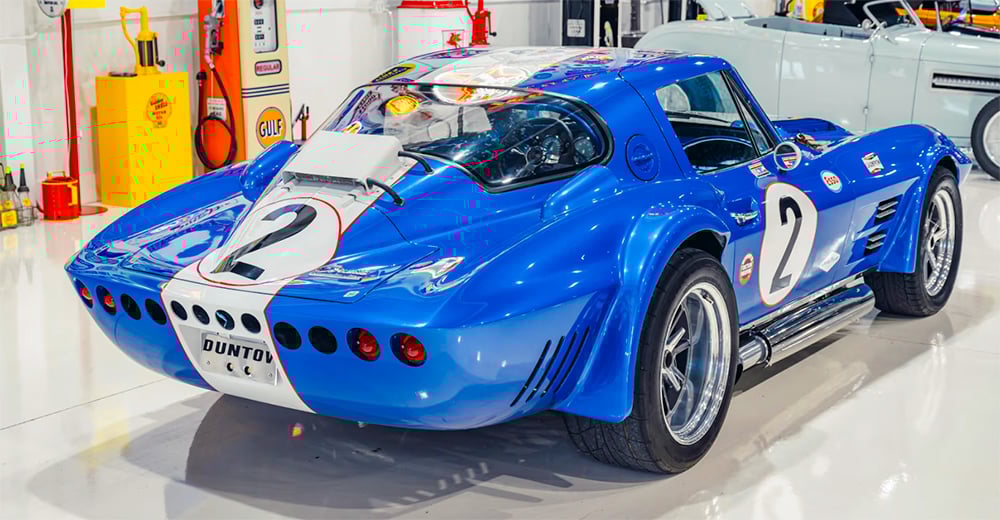
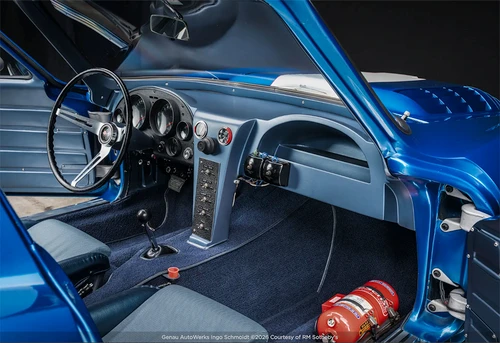
Above: The lead photo is of VIN serial number: 30837X100003 - 1963 Corvette Grand Sport race car #003 - which sold at RM Sotheby's Auction during Monterey Car Week 2026 for $18,705,000 USD. Details of the five 1963 Corvette Grand Sports are detailed in the video just above, this article, the video just below that details chassis #003 (video just below, lead photo of chassis #003 and others of #003 courtesy of Genau AutoWerks Ingo Schmoldt 2026 courtesy of RM Sotheby's). There are other videos as well. Enjoy!
Video: C2 Corvette Grand Sport: The Ultimate 1963 Corvette!
The Grand Sports were purpose-built Chevrolet Engineering competition machines conceived by Corvette Chief Engineer Zora Arkus-Duntov to take on Carroll Shelby's lightweight Cobras - and ultimately challenge the world's best sports cars at venues such as Sebring and Le Mans.
Chevrolet intended to build enough of them to qualify the Grand Sport as a production-based GT racer.
Instead, General Motors pulled the plug.
Only five were completed.
And astonishingly, all five survive today. (Revs Institute)
Those five chassis—001 through 005—would pass through the hands of Roger Penske, Jim Hall, A.J. Foyt, Dick Thompson, Dick Guldstrand, John Mecom, George Wintersteen and numerous other giants of American road racing.
More than six decades later, one of them has even rewritten the Corvette record books: in August 2026, Grand Sport 003 sold at RM Sotheby's Monterey auction for $18.705 million, becoming the most valuable Corvette ever sold at auction. (RM Sotheby's)
But to understand why these cars matter so much, we need to go back to the beginning.
Zora Duntov Wanted a Cobra Killer
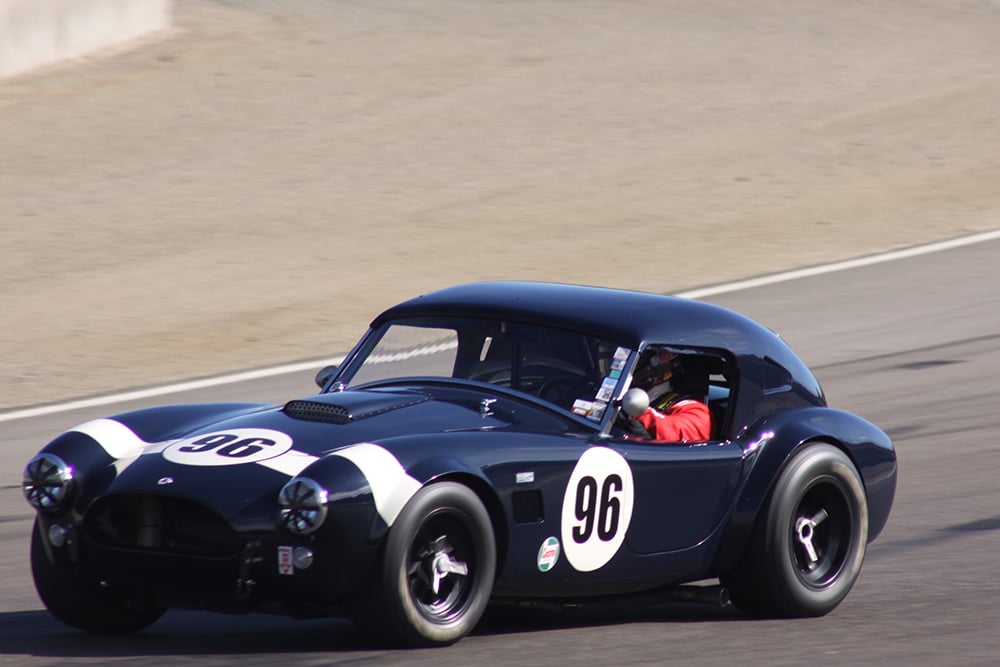
Above: Ken Miles GT Trophy class - James Farley (CEO of the Ford Motor Company) flying low in his jet black, removable hardtop and #96 roundel clad 1964 Shelby Cobra 289 looked great at speed or at rest - check it out here: Videos: Reliving the Glory of Vintage Racing at Laguna Seca Raceway (DBS photo).
When Chevrolet introduced the revolutionary second-generation Corvette for 1963, the Sting Ray was unquestionably advanced. It brought independent rear suspension, dramatically improved chassis engineering and styling that looked like nothing else on an American road.
But Duntov knew something else.
A production Corvette was simply too heavy to consistently beat Carroll Shelby's new Cobra.
The solution was not to modify the Sting Ray.
It was essentially to build another automobile underneath a Sting Ray-shaped skin.
Duntov and Chevrolet General Manager Semon "Bunkie" Knudsen pursued what became known internally as the lightweight Corvette program. The intent was to produce 125 cars, enabling homologation for international GT competition. (MotorTrend)
Grand Sport construction was centered around a large-diameter tubular steel frame rather than the conventional production Corvette chassis. Lightweight suspension pieces, an aluminum steering box, drilled components and an aluminum differential helped remove still more mass. The body was laid up in extremely thin fiberglass.
The result looked like a Corvette.
Underneath, however, it was a racing prototype.
According to period-based specifications preserved by the Revs Institute, Grand Sport 004 in its developed configuration weighs approximately 2,150 pounds, compared with well over 3,000 pounds for a street Sting Ray. (Revs Institute)
Other accounts put particular Grand Sport configurations closer to 1,980 pounds; the variation is understandable because these five experimental cars were continuously modified throughout their competition lives. (Corvette Action Center)
Grand Sport Engineering at a Glance
Among the specialized Grand Sport features were:
- Large-diameter tubular steel chassis
- Extremely thin fiberglass bodywork
- Fixed headlights under clear covers rather than production Sting Ray rotating headlamps
- Plexiglas side and rear glazing
- Lightweight suspension components
- Aluminum differential housing
- Girling four-wheel disc brakes
- Halibrand magnesium knock-off wheels
- Fiberglass competition interior
- Large-capacity racing fuel system
- Side-exit exhaust
- Numerous drilled, fabricated or one-off Chevrolet Engineering components
MotorTrend's historical account notes that early cars initially competed with modified 327-cubic-inch fuel-injected Chevrolet small-blocks, while Duntov's team developed much more exotic powerplants for the program. (MotorTrend)
And that leads us to one of the most misunderstood pieces of Grand Sport history.
What Engine Did the 1963 Grand Sport Actually Have?
There isn't one answer.
Grand Sports changed engines repeatedly.
The early race cars used versions of Chevrolet's production-based 327-cubic-inch small-block, including the L84 fuel-injected engine.
For the famous December 1963 Nassau campaign, however, Chevrolet Engineering transformed the cars.

A purpose-developed 377-cubic-inch small-block became the signature Grand Sport engine. Contemporary specifications identify a 4.00-inch bore and 3.75-inch stroke, aluminum block and heads, and four enormous twin-throat 58mm Weber side-draft carburetors. Published output varies according to configuration and source, generally ranging from approximately 485 horsepower to more than 500 horsepower. (Corvette Action Center)
An even more exotic Duntov-designed hemispherical-chamber, twin-plug engine reportedly produced approximately 550 horsepower on the dynamometer, although historical accounts differ on precisely which iterations were installed and raced. (Ultimatecarpage.com)
That distinction matters.
Saying simply that "every Grand Sport had a 550-horsepower 377" oversimplifies a development program in which engines, brakes, suspension, bodywork, wheels and cooling arrangements evolved continuously.
By 1966, the two Grand Sport roadsters—001 and 002—were running Chevrolet 427-cubic-inch big-blocks (Racing Sports Cars).
These cars never stopped evolving.
Chevrolet Pulls the Plug

Above: Zora Arkus-Duntov stands in front of a 1963 Corvette Sting Ray split-window coupe (photo courtesy of CorvSport.com)
The elephant in the engineering shop was General Motors' corporate stance against factory racing.
After learning the extent of the lightweight Corvette project following late-1962 testing, GM management ordered the program stopped. Duntov's plan to build the required homologation cars disappeared with only five completed. (Corvette Action Center)
That put the Grand Sport in an awkward racing position.
With nowhere near the required production quantity, it could not simply compete internationally as the production-derived GT automobile Duntov had envisioned. In many events it was pushed into Modified or Prototype categories against much more specialized machinery.
But the cars existed.
And Duntov was not about to let them sit quietly.
The Grand Sports began finding their way to trusted private racers.
That's where the individual histories become fascinating.
Grand Sport 001: From Experimental Coupe to Penske's Sunoco Roadster

Above: 1963 Corvette Grand Sports chassis #001 (photo courtesy of Carlisle Events)
Chassis 001 was the first Grand Sport constructed and remained within Chevrolet Engineering during the initial racing campaigns of 003, 004 and 005.
Following the spectacular late-1963 Nassau effort, Chevrolet began looking toward high-speed endurance racing in 1964.
Duntov had chassis 001 and 002 converted from coupes into low-windshield roadsters, reducing frontal area and aerodynamic drag in anticipation of races such as Daytona. (Collector Car Reports)
GM management intervened again before that plan could be fully realized.
The roadsters subsequently remained within GM until approximately 1966, when they finally emerged into private hands.
Roger Penske acquired Grand Sport 001 and equipped it with Chevrolet big-block power.
The car's most famous appearance came at the 1966 12 Hours of Sebring, finished in Penske's unforgettable blue-and-yellow Sunoco livery.
Video: Alain de Cadenet Drives Chassis #001 1963 Corvette Grand Sport!
Driving duties went to Dick Guldstrand and Dick Thompson.
The car qualified 21st and was running strongly before an accident ended its race. Racing Sports Cars records the car as a DNF, with Thompson and Guldstrand sharing the driving (Racing Sports Cars).
Its big-block engine and muscular open-body configuration made 001 perhaps the most visually intimidating incarnation of the entire Grand Sport program.
Today Grand Sport 001 is owned by collector Harry Yeaggy and has been restored in its celebrated 1966 Penske/Sunoco appearance. It appeared publicly alongside Grand Sport 004 at the 2026 Corvettes at Carlisle celebration. (Carlisle Events)
Grand Sport 002: The Remarkable Unrestored Survivor

Above: Chassis #002 1963 Corvette Grand Sport - preserved in unrestored condition (All images courtesy of Michael Furman for the SimeoneMuseum.org, where it is on display, fired up, and driven, with gusto no doubt, just as it should be.)
If 001 became the most recognizable roadster, Grand Sport 002 may be the most historically revealing of the five.
Like 001, it began life as a coupe before Chevrolet Engineering converted it into an open roadster after the 1963 Nassau campaign.

Roger Penske obtained both roadsters, but 002 soon went to Pennsylvania racer George Wintersteen.
Penske's operation prepared the car with a Chevrolet 427 big-block, and Wintersteen campaigned it extensively during 1966.
Racing Sports Cars records appearances that year at Cumberland, Bridgehampton, Mont-Tremblant, Mosport, Watkins Glen and Lime Rock. At Lime Rock, Wintersteen finished second overall and first in class (Racing Sports Cars).

Its white paint and broad blue stripe became one of the signature Grand Sport liveries.
But 002's later history makes it extraordinary.

Unlike its siblings, the car avoided a conventional full restoration.

Collector Jim Jaeger acquired 002 in 1990 while the machine remained substantially in its as-raced 1966 condition. The Simeone Foundation Automotive Museum describes it as the only one of the five never subjected to a traditional restoration and notes that original construction markings—including scribed, painted and wax-pencil notations applied by Chevrolet engineers—remain visible. (Simeone Foundation Automotive Museum)
Today 002 resides at the Simeone Foundation Automotive Museum in Philadelphia, making it one of the few original Grand Sports enthusiasts can see in a permanent public collection. (Simeone Foundation Automotive Museum)

For historians, that originality may make 002 every bit as important as its more successful racing siblings.

Grand Sport 003: The $18.7 Million Corvette

Above: Serial number: 30837X100003 - 1963 Corvette Grand Sport race car #003 - Sold at RM Sotheby's Auction during Monterey Car Week 2026 for $18,705,000 USD - Chassis #003 has an X in the sixth position, where every regular-production 1963 car has S for St. Louis. That's your first clue that this is not a production Sting Ray. Chevrolet built only five Grand Sports under Zora Arkus-Duntov before GM's ban on factory racing ended the program. Decoding the 1963-1967 C2 Corvette: VIN, Engine, Trim, & Paint Codes - this article is a huge help, if you have a C2 Corvette Sting Ray, or wish to purchase one (photo courtesy of the owner).

Grand Sport 003 may now be the most famous member of the family.

Above: Chassis #003 Grand Sport coupe 377 cubic inch V8 engine - the eight photos below are also of #003 (lead photo of chassis #003 and others of #003 courtesy of Genau AutoWerks Ingo Schmoldt 2026 courtesy of RM Sotheby's).
It was one of the cars released during 1963 for private competition and initially raced by Chicago-area Chevrolet dealer Dick Doane.
Doane put considerable mileage on 003 during the 1963 SCCA season, including appearances at Wilmot, Greenwood, Mid-Ohio, Meadowdale and Road America. Racing Sports Cars documents multiple strong finishes and class successes during that early campaign (Racing Sports Cars).

Above: Where the fun takes place in chassis #003
Then came Nassau.
For the 1963 Bahamas Speed Week, 003 joined Grand Sports 004 and 005 under the banner of Texas oilman and racing-team owner John Mecom Jr.

At various Nassau events, 003 was driven by Jim Hall, Augie Pabst and John Cannon.
Hall finished third in a preliminary race before mechanical trouble ended the Tourist Trophy. Pabst subsequently brought 003 home fourth in the Governor's Trophy, while Cannon finished eighth in the Nassau Trophy (Racing Sports Cars).

The car returned for the 1964 12 Hours of Sebring, this time driven by two exceptionally formidable racers: A.J. Foyt and John Cannon.
They finished 23rd overall after mechanical problems compromised the effort (Racing Sports Cars).
Grand Sport 003 continued competing through 1965 with drivers including Delmo Johnson, Dave Morgan, Ed Sevadjian and Jack Saunders.
Its list of period drivers eventually included:

Dick Doane, Ralph Salyer, Jim Hall, Augie Pabst, John Cannon, A.J. Foyt, Jack Saunders, Delmo Johnson, Dave Morgan and Ed Sevadjian (Racing Sports Cars).
That is a formidable racing résumé for one automobile.
Then, in August 2026, Grand Sport 003 crossed the block at RM Sotheby's Monterey auction.

The result:
$18,705,000
RM Sotheby's confirmed that the sale established a new world auction record for a Corvette. (RM Sotheby's)

The car was presented in its 1964 Sebring appearance and carried chassis/identification number 30837X100003 in the auction documentation. (RM Sotheby's)
In monetary terms, 003 has therefore become the most valuable Corvette ever sold publicly.
Historically, however, its value lies in something much harder to measure. It is one of the handful of automobiles that demonstrate just how serious Chevrolet's secret competition effort really was.

Grand Sport 004: The First Grand Sport to Win

Above: As the tiny type just beneath the photo indicates, Bruce Canepa pilots his chassis #004 1963 Corvette Grand Sport coupe at the vintage races of WeatherTech Raceway Laguna Seca (three photos here courtesy of UltimateCarPage.com at the 2008 Monterey Historics).
Here's an important correction to Grand Sport folklore.
Some older accounts state that chassis 004 won its first race at Connellsville, Pennsylvania.
Contemporary race databases tell a different story.
Racing Sports Cars lists Grand Sport 004 as entered for Connellsville on August 11, 1963, but indicates it did not arrive, with uncertainty over whether it actually ran (Racing Sports Cars).

The documented first Grand Sport overall victory came two weeks later.
On August 24, 1963, Dr. Dick Thompson—"The Flying Dentist"—drove Grand Sport 004 to victory at the SCCA National event at Watkins Glen (Racing Sports Cars).
That makes 004 historically important even before Nassau enters the picture.
The car initially raced for Grady Davis, the influential Gulf Oil executive whose competition program was closely aligned with Chevrolet development efforts.
During 1963 Thompson campaigned 004 at Marlboro, Virginia International Raceway, Cumberland, Bridgehampton, Road America, Lake Garnett and Meadowdale before scoring the breakthrough Watkins Glen victory (Racing Sports Cars).
For Nassau, Chevrolet transformed the car.
Wider wheels and tires, pronounced fender flares, cooling modifications and the 377-cubic-inch engine turned the formerly comparatively narrow lightweight into the brutal-looking Grand Sport most enthusiasts recognize today.
Roger Penske drove 004 to third overall in the December 6 Governor's Trophy at Nassau, while Thompson finished fourth overall in the December 8 Nassau Trophy (Racing Sports Cars).
Those results are crucial to the legend because the Grand Sports were racing among sophisticated sports-racing prototypes—not merely production automobiles.
Grand Sport 004 continued racing through the mid-1960s with drivers including Thompson, Penske, Don Yenko, Delmo Johnson and others. It even appeared at the 1967 Daytona 24 Hours with a 427-cubic-inch engine (Racing Sports Cars).

Today, 004 belongs to the Revs Institute in Naples, Florida, where it is preserved as part of one of America's great competition-car collections. (Revs Institute)
Unlike many priceless historic automobiles, Revs has also exercised the car on track—allowing later generations to see and hear what a genuine Grand Sport was built to do.
Grand Sport 005: The Winningest of the Five

Above: Chassis #005 1963 Corvette Grand Sport (photo courtesy of the Corvette Blogger)
If 004 scored the Grand Sport's breakthrough victory, 005 built perhaps the strongest competition résumé.
Racing Sports Cars' surviving records credit chassis 005 with three overall victories, additional class wins, six podium finishes and a 75-percent finishing rate across its recorded appearances between 1963 and 1965 (Racing Sports Cars).
It participated in the famous 1963 Nassau campaign alongside 003 and 004.
Dick Thompson drove 005 to second in the preliminary Nassau event and sixth in the Governor's Trophy (Racing Sports Cars).

Above: 1963 Corvette Grand Sport #005 (photo courtesy of MotorTrend)
But 005's biggest moment came the following spring.
At the 1964 12 Hours of Sebring, Roger Penske and Jim Hall drove Grand Sport 005 to a class victory. The performance became one of the high points of the entire Grand Sport program. (MotorTrend)
Later that year, Penske returned with the car to Nassau and scored another important victory.
Over the course of its career, 005 was driven by Penske, Hall, Thompson, George Wintersteen, Hap Sharp, Ben Moore and others (Racing Sports Cars).
And 005 has another fascinating connection with Chevrolet history.
Video: Owner Bill Tower Provides a Walk Around Video of Chassis #005 -1963 Corvette Grand Sport
Former Chevrolet engineer Bill Tower acquired the car in the late 1970s. Tower had actually worked around Grand Sport 005 during his Chevrolet Engineering career and eventually became its caretaker.
He has retained the car for decades. (MotorTrend)
In a wonderful bit of Grand Sport lore, the car also reportedly survived a devastating flood while in earlier owner Dave Irwin's collection. Other cars were swept away, while the lightweight Corvette floated on its tires inside the building until becoming wedged against structural objects. (MotorTrend)
Sometimes history survives by engineering.
Sometimes it survives by luck.
Grand Sport 005 got a little of both.
Nassau 1963: When the Grand Sports Became Legends
Much of the mythology surrounding these five automobiles can be traced to one week in the Bahamas.
The 1963 Nassau Speed Week finally gave the developed Grand Sports an opportunity to demonstrate what Duntov had envisioned.
Three cars—003, 004 and 005—appeared under John Mecom's banner.
And they were fast.
In a preliminary over-two-liter race, Grand Sport 005 with Dick Thompson finished second and Grand Sport 003 with Jim Hall third. Both finished ahead of Ferrari 250 GTO and Cobra entries in that particular event (Racing Sports Cars).
In the Governor's Trophy on December 6:
- Roger Penske / Grand Sport 004 — 3rd
- Augie Pabst / Grand Sport 003 — 4th
- Dick Thompson / Grand Sport 005 — 6th
Racing Sports Cars' surviving event records confirm the order (Racing Sports Cars).
The Grand Sports hadn't merely shown speed.
They had demonstrated that Chevrolet Engineering had created a machine capable of running at the front against serious international racing hardware.
That was the tantalizing part.
The Grand Sport had reached competitive maturity just as the corporate door slammed shut.
Five Cars, Two Very Different Body Styles
All five Grand Sports were originally constructed as coupes.
That point sometimes gets muddled because photographs of 001 and 002 as roadsters are so familiar.
Their histories can be summarized this way:
|
Chassis |
Original Configuration |
Later Configuration |
Major Association |
|
001 |
Coupe |
Roadster |
Roger Penske / Sunoco |
|
002 |
Coupe |
Roadster |
George Wintersteen |
|
003 |
Coupe |
Coupe |
Doane / Mecom / Foyt |
|
004 |
Coupe |
Coupe |
Grady Davis / Dick Thompson |
|
005 |
Coupe |
Coupe |
Jim Hall / Roger Penske |
The roadster conversions occurred after the successful 1963 Nassau campaign as Duntov explored reduced frontal area for faster endurance circuits. Collector Car Reports
Thus, the original production total is properly understood as five coupes built, with two later converted into roadsters—not three coupes and two roadsters constructed from the outset.
Where Are the Five Original Grand Sports Today?
All five survived, a remarkable outcome considering how heavily they were raced and modified.
As of 2026:
Grand Sport 001 — Harry Yeaggy collection; restored in Penske/Sunoco 1966 Sebring configuration. (Carlisle Events)
Grand Sport 002 — Simeone Foundation Automotive Museum, Philadelphia; exceptionally original 1966-era survivor. (Simeone Foundation Automotive Museum)
Grand Sport 003 — Sold by RM Sotheby's at Monterey in August 2026 for $18.705 million; the buyer was not publicly identified in the auction material reviewed for this article. (RM Sotheby's)
Grand Sport 004 — Revs Institute, Naples, Florida. (Revs Institute)
Grand Sport 005 — Longtime Bill Tower collection. (MotorTrend)
Five built.
Five survived.
That alone borders on miraculous.
Grand Sport Quick Specifications
Because the cars constantly evolved, there is no single specification that accurately describes every Grand Sport throughout its life. The following represents the developed 1963-era configuration most enthusiasts associate with the cars.
|
Specification |
1963 Corvette Grand Sport |
|
Number constructed |
5 |
|
Original body style |
Coupe |
|
Roadster conversions |
Chassis 001 and 002 |
|
Wheelbase |
98 inches |
|
Frame |
Purpose-built tubular steel |
|
Body |
Lightweight fiberglass |
|
Engine, early configuration |
327-ci Chevrolet small-block V8 |
|
Famous Nassau engine |
377-ci small-block V8 |
|
Induction |
Four twin-throat 58mm Weber carburetors |
|
Published output |
Approximately 485 hp depending on configuration |
|
Transmission |
4-speed manual |
|
Brakes |
Four-wheel Girling discs |
|
Wheels |
Halibrand magnesium knock-offs |
|
Approximate racing weight |
Roughly 2,000–2,150 pounds depending upon configuration |
Technical references: (Corvette Action Center)
Why Didn't Chevrolet Build 125 Grand Sports?
And here lies perhaps the greatest "what if?" in Corvette history.
Had Chevrolet completed 125 examples and achieved homologation, the Grand Sport could have contested international GT racing in the category for which Duntov designed it.
It might have met Cobras, Ferrari GTOs and other celebrated machines on substantially different terms.
Instead, Chevrolet's lightweight was forced into classes where it often faced pure racing prototypes.
The statistics therefore don't tell the entire story.
The Grand Sport's importance lies partly in what it accomplished—but perhaps even more in what its engineering demonstrated was possible.
A roughly two-thousand-pound Corvette with close to 500 horsepower, four-wheel disc brakes, independent suspension and aerodynamic development was an outrageous machine in 1963.
It also showed something about Duntov himself.
He didn't simply want Corvette to look like a sports car.
He wanted Corvette to beat sports cars.
Five Corvettes That Changed the Meaning of Corvette
There would eventually be faster Corvettes.
There would be Corvettes with more horsepower, better aerodynamics, greater endurance-racing success and far more sophisticated chassis.
But none could recreate the circumstances that produced the original five Grand Sports.
They were born inside one of the world's largest corporations while that same corporation officially wanted nothing to do with racing.
They were engineered in tiny numbers.
They were handed to private teams.
They were constantly revised.
They were driven by some of the finest American racers of their generation.
And just as the development program began demonstrating how formidable the car could become, it was stopped.
That unfinished business may be precisely why enthusiasts remain obsessed with them.
001. 002. 003. 004. 005.
Five chassis numbers representing one of the most extraordinary experiments in Chevrolet history.
Duntov wanted to build 125.
He got five.
Turns out, five were enough to create a legend.
Parts Unlimited Interiors Sells Corvette Interior Items

Whether you have a Corvette that's restored, restomodded, a 1963 Corvette Grand Sport replica - or on the way to any of these three great results, there's a great chance that Parts Unlimited Interiors can help you out with some Corvette cockpit components.
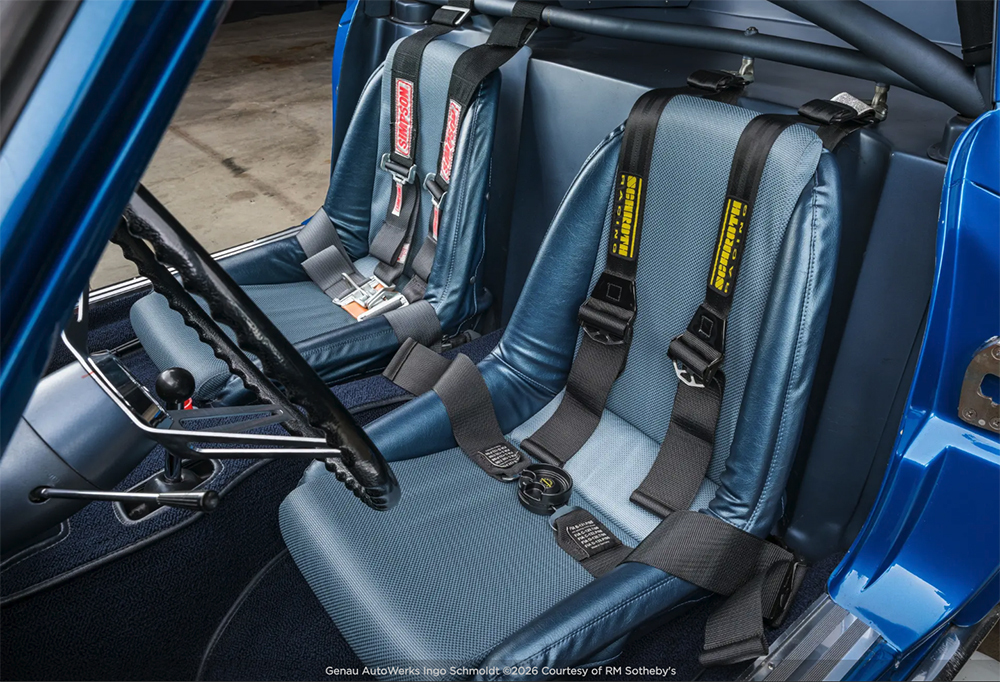
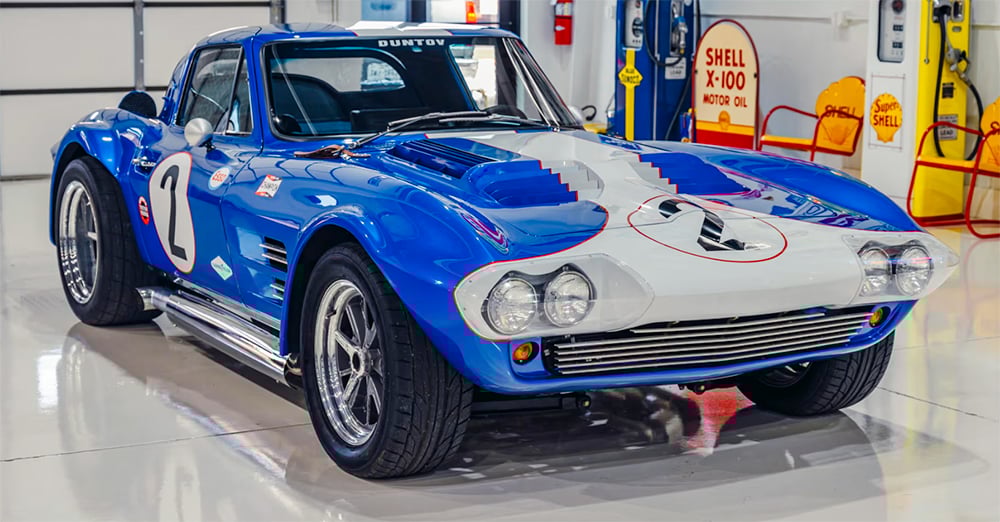
Above and below: 1963 Chevrolet Corvette Grand Sport replica (photos courtesy of Mecum Auctions): Build details available here - Videos: Original vs Restomod Route for Your C1 or C2 Corvette