
The Rare Legend of the 1970 Chevrolet Chevelle 454 SS LS6
Posted by D. Brian Smith on Aug 7th 2026
 If you’re the kind of person who can recognize a big-block idle from half a block away, you already know the 1970 Chevrolet Chevelle SS 454 occupies a sacred corner of muscle-car history. But within that world, there’s a particular halo car: the LS equipped factory-installed big-block (Chevrolet’s baddest in the Chevelle lineup), and one of the defining “peak muscle” statements of the era.
For Classic Industries enthusiasts (and anyone who’s ever looked twice at a cowl-induction hood), the LS6 story is more than a spec sheet - it’s the sound, stance, scarcity, and swagger that made the 1970 Chevelle a benchmark. And when you narrow the focus to body styles, the hardtop is rare enough to make collectors lean in. The convertible? That’s the really scarce item.
1970: When Muscle Cars Hit Their Loudest Note

Above and below: 1970 LS6 454 big block V8 in a 1970 Cortez Silver Chevrolet Chevelle SS LS6 coupe (photos courtesy of Mecum Auctions)
The 1970 model year landed right at the crest - when compression was high, displacement was king, and the factory was still willing to sell you something that felt like it belonged on the starting line. Chevrolet’s midsize A-body platform (Chevelle and Malibu) had already proven itself in the street-performance arms race, and the SS package was the badge of intent.
But 1970 didn’t just bring another set of stripes - it brought the new 454-cubic-inch big-block option, and with it, two distinct personalities:
-
LS5 454: the more common (but still formidable) big-block SS offering
-
LS6 454: the top-tier, all-in performance engine that turned the Chevelle into a street-legal sledgehammer

The LS6 wasn’t about subtlety. It was about arriving, idling with authority, and leaving behind a memory—and maybe a faint haze—every time the throttle opened.
LS6: The Factory Big-Block That Defined “Serious”
The LS6 is often spoken of in the same breath as the greatest muscle-car engines ever built - and for good reason. It wasn’t merely a large-displacement option; it was a carefully engineered high-performance package that combined big torque with the kind of top-end pull that made 1970-era stoplight folklore believable.

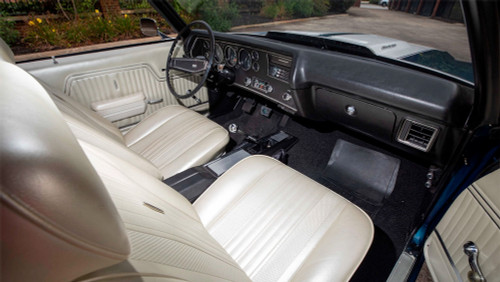
Above and below: 1970 Chevelle SS 454 LS6 interior driver's side and passenger side, respectively (photos courtesy of GM Authority)
From the driver’s seat, what matters is this: an LS6 Chevelle doesn’t feel like it’s working hard. It feels like it’s waiting - for the secondaries, for the tires to give up, for the road to clear. It’s the kind of powertrain that makes the car feel heavier and lighter at the same time: heavy in presence, light in effort.

And it’s not only the engine. The LS6 Chevelle experience is a full sensory package:
-
The cowl-induction hood that looks like it means business even at a standstill
-
The deep, quick bark of a big-block when the throttle snaps open
-
The rear-end squat that turns acceleration into a visual event
-
The unmistakable “A-body” proportions—tight, muscular, and ready to lunge

Above: Cowl induction hood on a 1970 Chevelle SS 454 LS6 that's painted Fathom Blue and has white SS stripes
Hardtop: The Classic LS6 Silhouette
When most people picture a 1970 Chevelle SS, they’re picturing the hardtop - the iconic roofline, the clean side glass, and that perfect muscle-car profile that looks like it’s leaning forward even when parked. In collector circles, the hardtop is the signature look, and it’s where the LS6 story is most often told.

Above: 1970 Chevelle SS 454 LS6 - also the lead photo car (photos courtesy of Mecum Auctions)
Why does the hardtop matter? Because it delivers the “pure” Chevelle SS shape - arguably the best balance of aggression and elegance in the A-body family. It’s the form that best matches the function: a car built for power wearing a body that looks like it was carved out of momentum.
The hardtop LS6 is rare, desirable, and historically significant - the kind of car that anchors collections and turns casual onlookers into instant photographers at a cruise-in.
Convertible: Rarer Still, and a Whole Different Kind of Cool

Above: 1970 Chevrolet Chevelle SS 454 LS6 convertible (photo courtesy of GM Authority)
Then there’s the LS6 convertible - the one that changes the whole vibe without changing the mission.
Convertibles were always the minority choice in serious performance circles. They cost more, added weight, and - depending on who you asked - weren’t “as rigid” or “as track-ready” as a hardtop. But that’s exactly why the LS6 convertible is so fascinating: it represents the buyer who wanted maximum performance and maximum presence, no compromises on the experience.

Above and below: 1970 Chevrolet Chevelle SS 454 LS6 convertible interior (photo courtesy of GM Authority)
Drop the top, and the LS6 becomes even more visceral. The sound doesn’t bounce off glass - it pours out of the car. The sensation of speed isn’t just in your hands and back; it’s in your ears, your shoulders, the air moving around the windshield frame. An LS6 convertible is the muscle-car equivalent of front-row seats: same show, but now you’re inside it.

And because far fewer were ordered, the convertible sits at the top of the rarity pyramid - an already hard-to-find Chevelle configuration made extraordinary by the LS6 drivetrain.

Above: 1970 Chevrolet Chevelle SS 454 LS6 convertible in Cranberry Red (photo courtesy of Mecum Auctions)
What Makes a Real LS6 Chevelle So Special Today?

Above: 1970 Chevelle SS 454 LS6 (photo courtesy of Mecum Auctions)
In the modern collector world, rarity alone doesn’t create legends. The LS6 has something better: it has myth plus proof. It’s one of those cars that earned its reputation when it was new—and has spent the decades since confirming it.
Here’s why the LS6 Chevelle still hits differently:
1) It’s a “peak era” car.
1970 represents the last moment before tightening emissions rules, falling compression ratios, and insurance realities started sanding down the sharp edges.

Above: 1970 Chevrolet Chevelle El Camino SS 454 LS6 (photo courtesy of Mecum Auctions)
2) It’s a factory-built performance statement.
Plenty of cars can be modified into monsters. The LS6 was born that way - ordered from a dealership, delivered with intent, and driven home with the same engine that made it famous.
3) It has the look.
Some muscle cars are fast but visually awkward. The 1970 Chevelle SS has one of the most universally loved designs in the segment - clean lines, muscular fenders, and just enough brightwork to feel premium without losing menace.

Above: 1970 Chevelle SS 454 LS6 coupe (photo courtesy of Mecum Auctions)
4) The body-style hierarchy adds intrigue.
Hardtops are the iconic form. Convertibles are the crown jewel. El Camino variant for the coupe/utility, "Ute" fans. Same legendary foundation - different collector narratives.
Restoration and Authenticity: Why the Details Matter

Above and below: 1970 Chevelle SS 454 LS6 Cortez Silver (photo courtesy of Mecum Auctions)
With a car this desirable, details matter - because the difference between “a 1970 Chevelle with a big-block” and “a documented LS6 SS” is the difference between a fun story and a serious one.
For restorers, that means sweating the exact pieces that make the car feel right:
-
Correct-looking engine-bay components and finishes
-
Proper interior trims, badges, and instrumentation
-
Period-correct wheels, stance, and tire profile
-
The right SS cues - subtle in isolation, unmistakable together

And for enthusiasts, it’s about honoring what the car is: not just fast, but historically specific. The LS6 Chevelle isn’t famous because it can be replicated. It’s famous because it captured a moment that can’t be repeated.
The LS6 Chevelle in 2026: Still the Benchmark
So why does the 1970 Chevelle 454 SS LS6 still matter today? Because even in a world full of modern horsepower, the LS6 Chevelle delivers something that can’t be downloaded: drama.
It’s the mechanical honesty of a big-block.
It’s the posture of an A-body at full torque.
It’s the feeling that the car is always one throttle stab away from turning the street into a story.
The hardtop is the classic, the image burned into muscle-car culture.
The convertible is the rarer thrill - the same legend, but louder, wilder, and exposed to the world. The El Camino might have been the mighty workhorse back in the day.

Above: 1970 Chevelle SS 454 LS6 convertible (photo courtesy of Mecum Auctions)
For Classic Industries enthusiasts, the LS6 Chevelle remains more than a car - it’s a reference point. A reminder of when performance was unapologetic, style was bold, and the only traction control was your right foot.
LS6 Chevelle Quick Facts (1970)
Model:
1970 Chevrolet Chevelle SS 454 (Z15)
Top Engine Option:
LS6 454 cubic-inch V8 (RPO LS6)

Factory Rated Output:
450 horsepower @ 5,600 rpm
500 lb-ft of torque @ 3,600 rpm
(Gross ratings, as published in 1970)
Compression Ratio:
High-compression big-block (one of the highest-performance factory engines of the muscle-car era)

Above: 1970 Chevelle SS 454 LS6 in gold (photo courtesy of Mecum Auctions)
Induction:
Factory cowl-induction hood (functional, vacuum-operated)
Transmissions Available:
- Muncie 4-speed manual
- Turbo Hydra-Matic automatic

Rear Axle Options:
Heavy-duty 12-bolt rear with multiple performance gear ratios available
Parts Unlimited Interiors - a Leading Supplier of GM Interior Items
The 1966 Chevrolet Chevelle restomod has seat covers from Parts Unlimited Interiors. And incase you didn't know, Parts Unlimited Interiors has an absolute abundance of American made interior items for the Chevrolet Chevelle.