


The Legendary Trans Ams of 'Smokey and the Bandit': A Hidden History
Posted by D. Brian Smith on Aug 7th 2026
 Few automobiles have ever become as inseparable from a motion picture as the black-and-gold Pontiac Trans Am from Smokey and the Bandit. James Bond had his Aston Martins, Steve McQueen had his Highland Green Mustang, and the Duke boys had the General Lee—but no Hollywood car did more to transform the fortunes of an American performance model than the 1977 Pontiac Trans Am.
Ironically, the most famous "1977" Trans Am in history wasn't actually a 1977 model.
It was one of four pre-production 1976 Trans Ams disguised to look like Pontiac's all-new 1977 model. Those four cars endured hundreds of high-speed chase scenes, one of the greatest movie jumps ever filmed, countless collisions, and a level of abuse that eventually left every one of them either destroyed or cannibalized for parts.
Above top: Lead photo courtesy of the film 'Smokey and the Bandit'
Video: 'Smokey and the Bandit' - 'East Bound and Down' - Jerry Reed
This is their story.
Pontiac Needed a Hero

Above: 1977 Pontiac Firebird Trans Am (photo courtesy of Mecum Auctions)
By 1976, Pontiac's muscle car glory days appeared to be fading.
Insurance rates had skyrocketed.
Federal emissions regulations had slashed horsepower.
The legendary Super Duty 455 was gone.
Yet Pontiac still offered one of America's most exciting performance cars—the second-generation Firebird Trans Am.
Director Hal Needham immediately knew the Trans Am had to become the Bandit's signature car. It wasn't merely transportation—it would become another character in the film.
Needham contacted Pontiac, which eagerly agreed to provide vehicles in exchange for product placement. GM supplied four Trans Ams along with Pontiac LeMans sedans that would serve as Sheriff Buford T. Justice's patrol cars.
The timing couldn't have been better.
Pontiac hadn't officially introduced the redesigned 1977 Trans Am yet.
They Were Actually 1976 Models

Above: 1976 Pontiac Firebird 50th Anniversary Special Edition (photo courtesy of Bring a Trailer)
One of Hollywood's best-kept automotive secrets is that every Trans Am used during filming began life as a 1976 Special Edition.
Since production started before the 1977 models were available, Pontiac built the cars using 1976 bodies fitted with the upcoming 1977 front-end sheetmetal.
The changes included:
- Four rectangular headlights
- New grille design
- Revised nose
- Updated front fascia
- 1977 graphics
- "6.6 LITRE" hood scoop decals
Only dedicated Pontiac enthusiasts noticed that certain scenes still revealed clues, including the 1976 Honeycomb wheels appearing in several shots.
Under the Hood

Above: 1976 Pontiac Firebird 50th Anniversary Special Edition, equipped with its 455 cubic inch V8 engine (photo courtesy of Bring a Trailer)
Although audiences believed they were watching brand-new 1977 Trans Ams, the movie cars were powered by engines unavailable in the actual production 1977 cars.
The stunt cars retained Pontiac's 455-cubic-inch V8, the final year for that legendary engine before its retirement.
Typical specifications included:
Engine
- Pontiac 455 V8
- Rochester Quadrajet four-barrel
- Approximately 200 net horsepower
- Massive low-end torque
Transmission
- Turbo Hydra-Matic automatic
Rear Axle
- 10-bolt limited-slip
Suspension
- WS6 package not yet available
- Front disc brakes
- Rear drum brakes
Appearance
- Starlight Black
- Gold Special Edition graphics
- Gold snowflake wheels
- Hurst T-Tops

Above: Front snowflake wheel (photo courtesy of Mecum Auctions)
While the horsepower numbers appear modest today, the enormous torque made the cars exceptionally well-suited for long smoky burnouts and dramatic acceleration on dirt roads.
The Hero Cars
Like nearly every action film, each Trans Am had a specific assignment.

Above: 1977 Pontiac Firebird Trans Am (photo courtesy of Mecum Auctions)
Car No. 1 — The Beauty Car
Used for:
- Close-ups
- Promotional photography
- Static scenes
- Driving dialogue
- Interior shots
This car generally endured the least punishment.
Car No. 2 — General Stunt Car

Above: Possibly the stunt car at speed with Burt Reynolds at the wheel (photo courtesy of the film, 'Smokey and the Bandit')
Responsible for:
- Dirt road slides
- Burnouts
- Police chases
- High-speed cornering
- Mailbox crashes
- Everyday stunt work
It absorbed tremendous punishment throughout filming.
Car No. 3 — The Jump Car

Above: Definitely the jump car at speed with director/stunt man Hal Needham at the wheel (photo courtesy of the film, 'Smokey and the Bandit')
The most famous Trans Am in movie history.
This car performed the unforgettable leap across the broken Mulberry Bridge.
It was also the most heavily modified.
Car No. 4 — Spare Parts Car
As production continued and damage accumulated, this vehicle increasingly became a donor.
Panels, suspension pieces, trim, wheels, and countless mechanical parts were removed to keep the remaining Trans Ams operating.
By the end of filming, none remained untouched.
The Legendary Bridge Jump

The bridge jump remains one of the greatest practical automotive stunts ever captured on film.
Unlike modern CGI, Hal Needham insisted on doing the stunt for real.
Above: Burt Reynolds and Hal Needham between scenes while filming 'Smokey and the Bandit' (photo courtesy of the movie)
The production discovered an actual bridge that had washed away.
Needham calculated:
- distance
- elevation
- landing angle
- required launch speed
Then his crew constructed a concealed launch ramp.
 Above: Behind the scenes photo during filming (photo courtesy of Instagram)
The problem?
The stock automatic Trans Am couldn't accelerate quickly enough on the short dirt approach.
Needham's solution was pure racer thinking.
Owning a NASCAR race team, he simply called his shop.
"Send me a 750-horsepower engine and a stick transmission."
Those became the only major performance modifications made to a movie Trans Am beyond the required safety equipment.
The Rocket Booster
One persistent story surrounding the jump is absolutely true.
The jump car also carried a rocket-assisted booster system similar to equipment associated with Evel Knievel's stunt program, providing additional acceleration during the launch sequence.
Hal Needham himself drove the jump car.
Stunt performer Lada St. Edmund doubled for Sally Field.
The Trans Am flew approximately 150 feet before landing hard enough to bend the chassis.
Although the car survived the jump, it was never truly the same afterward.
They Weren't Built to Survive

Above and below: 1977 Pontiac Firebird Trans Am (photos courtesy of Mecum Auctions)
Unlike modern stunt vehicles featuring reinforced roll cages, racing suspensions, and custom-built drivetrains, these were essentially production cars.
Every chase scene added more damage.
Broken:
- control arms
- shocks
- transmissions
- steering components
- body panels
- wheels
- glass
- suspension mounts

Eventually the crew began stripping wrecked cars to repair the remaining survivors.
Needham later joked that by the final days of filming they had "beat the crap out of those cars."
Continuity Problems Tell the Story
Watch the movie carefully and you'll notice evidence of the cars' gradual destruction.
Among the continuity errors:
- dents disappear
- damaged fenders become straight
- wheels change styles
- trim appears and disappears
- body panels suddenly become undamaged
Even Buford T. Justice's LeMans patrol car mysteriously changes body panels because the crew kept swapping replacement parts between damaged police cars.

Video: The Last Scene
Above: The last scene (courtesy of the film 'Smokey and the Bandit' and YouTube Video)
Perhaps the greatest testament to the punishment these Pontiacs endured comes from the movie's closing moments.
According to Hal Needham, the final surviving Trans Am could no longer run under its own power.
To complete the last shot:
The crew pushed the car into position with another vehicle so Burt Reynolds could climb out and finish filming.
After the cameras stopped rolling, there were effectively no usable Trans Ams left from production.
What Happened to the Cars?
This question has fascinated enthusiasts for nearly fifty years.
The unfortunate answer:
None of the four principal filming cars are confirmed to have survived.
Most were:
- wrecked
- dismantled
- stripped for usable components
- ultimately scrapped after production ended
Over the decades numerous "original movie cars" have surfaced, but none have been conclusively documented as one of the four screen-used stunt vehicles.
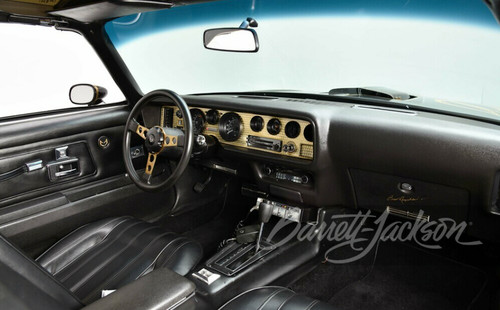
Burt Reynolds' Trans Am

Above and below: Burt Reynolds sold his 1977 Pontiac Firebird Trans Am in late 2014. The car was reunited again with Mr. Reynolds when it returned as the centerpiece in the '2019 Bandit Run,' which ended with a visit to his Florida estate. This event was the last for Mr. Reynolds, and he thoroughly enjoyed being reunited with his former car, signing the glovebox door (photo courtesy of SupercarBlondie). The signed glovebox door photo courtesy of Barrett-Jackson, as evidenced by the B-J watermark on the photo below as well as others that follow (RIP Mr. Reynolds).

One car frequently mistaken for a screen-used vehicle was Burt Reynolds' personal promotional Trans Am.
Pontiac presented Reynolds with a black-and-gold Trans Am used during promotional appearances for the film.

Although closely associated with Smokey and the Bandit, this car never actually appeared on screen.
It later sold at auction for an astonishing $450,000, demonstrating the enduring appeal of the Bandit legend.

The Movie That Saved the Trans Am
Perhaps no automobile benefited more from Hollywood exposure.
Released in May 1977, Smokey and the Bandit became a cultural phenomenon.
The black-and-gold Special Edition Trans Am instantly became America's dream car.
Pontiac dealers couldn't keep them in stock.
Within two years:
- Trans Am sales nearly doubled.
- Demand exceeded production.
- The Firebird outsold the Chevrolet Camaro for the first time in history.
For Pontiac, the film accomplished something millions of advertising dollars never could.
It made the Trans Am cool.
Why Enthusiasts Still Love the Bandit Trans Am

Nearly five decades later, enthusiasts continue restoring authentic Y82 and Y84 Special Edition Trans Ams into Bandit replicas.
The formula remains timeless:
- Starlight Black paint
- Gold pinstriping
- Gold snowflake wheels
- Gold "Screaming Chicken"
- Hurst Hatch roof
- Shaker scoop
- Gold engine-turned dash
- Camel deluxe interior
Even people who have never watched the movie instantly recognize the car.
That's the mark of a true automotive icon.
Final Thoughts
Hollywood has produced countless memorable movie cars, but very few changed automotive history.

Above: 1968 Mustang Bullitt stunt car #558 at the Petersen Automotive Museum (photo courtesy of DBS)
The Bullitt Mustang elevated the fastback Mustang to legendary status.
The General Lee turned the Dodge Charger into a television icon.

Above: 1969 Dodge Charger General Lee used in the 2005 movie, 'The Dukes of Hazzard' (photo courtesy of Bonhams Auctions)
But the four battered Trans Ams from Smokey and the Bandit accomplished something unique—they revitalized an entire model line during one of the darkest periods in American performance-car history.
The irony is almost poetic.
None of the four screen-used cars lived long enough to enjoy their fame.
They were sacrificed one dent, one jump, and one burnout at a time to create a film that forever cemented the Pontiac Trans Am as one of the most beloved muscle cars ever built.
Nearly fifty years later, every black-and-gold Special Edition Trans Am still carries a little of the Bandit's swagger - and a reminder that sometimes the greatest legends are the ones that don't survive.

Pontiac Firebird Interior Items Jumping Off the Shelves at Parts Unlimited Interiors
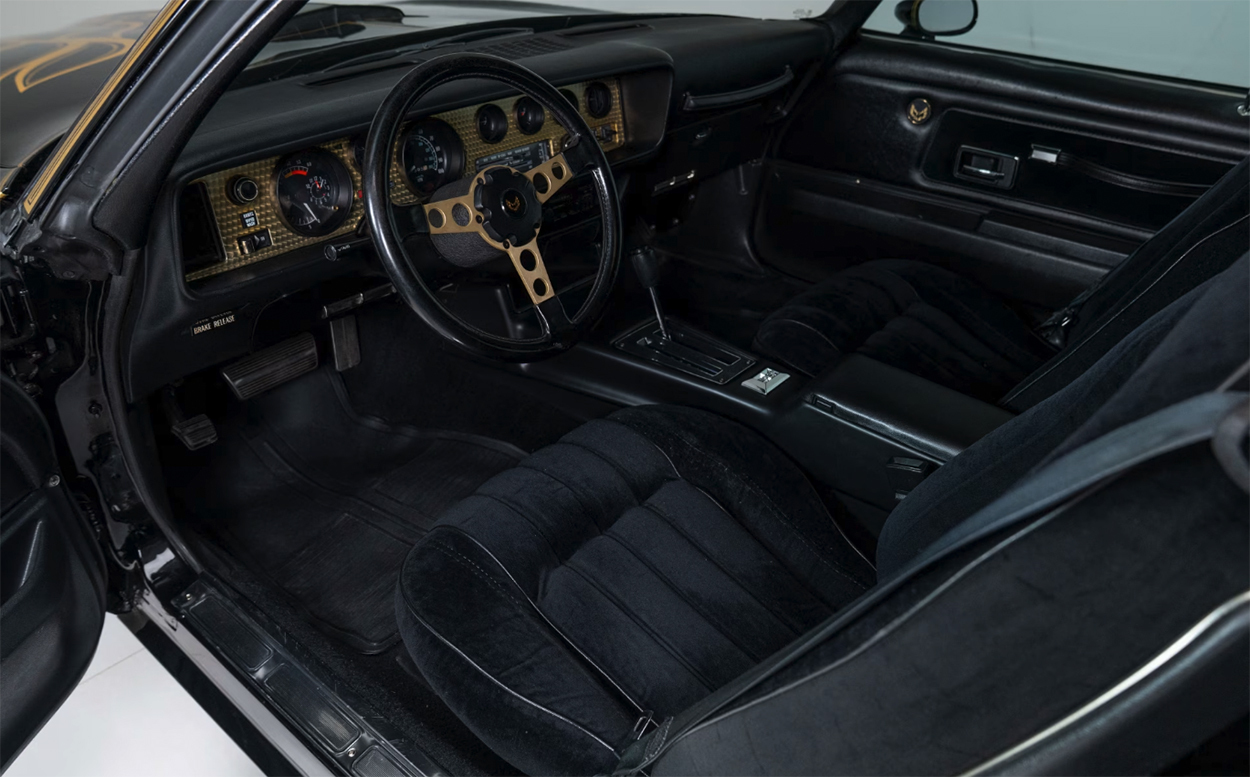
Regardless of your year of Pontiac Firebird, there is a great opportunity to renew your Firebird's interior with American manufactured, top-quality soft goods and hard goods from Parts Unlimited Interiors. You've come to the right place, if your Firebird's nest needs to be restored. Make Sally Field and Burt Reynolds feel right at home, should you give them a lift in your Trans Am.
